

 by
by If you’ve ever walked your dog at night and noticed them moving around like they own the darkness, you’re not alone. Many pet owners assume dogs can see in total darkness — almost like they have built-in night goggles. The truth? Not exactly. But their night vision is far better than ours in low light.
Let’s break down how dogs see at night, what limits they have, and how you can keep them safe when the sun goes down.
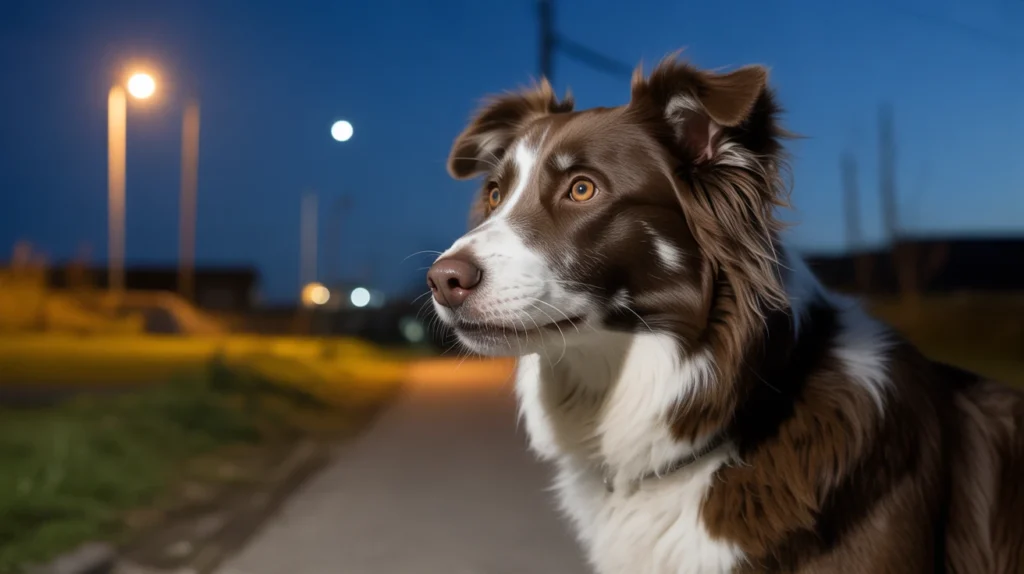
Content
Understanding Dog Eye Anatomy (Can Dogs See In The Dark?)
A dog’s eye is designed to capture as much light as possible. Here are the key parts that play a role in their night vision:
- Retina ? Converts light into signals the brain can understand
- Rods ? Help see in low light (dogs have way more rods than humans)
- Cones ? Detect color (dogs have fewer cones than us)
- Pupil ? Expands wider to let in more light at night
- Lens ? Focuses light onto the retina
- Tapetum lucidum ? A reflective layer that boosts night vision and causes the eye glow we see in photos
That shiny glow in their eyes when a light hits them in the dark? That’s the Tapetum Lucidum doing its job.
Here’s How Dogs See In The Dark
1. More Rods Than Cones = Better Low-Light Vision
Dogs are built to see movement and shapes in dim lighting. Their retinas are packed with rods, which are far more sensitive to light than cones. This is why your dog can easily detect a toy moving in the yard at night even when you can barely see it.
2. Larger Pupils Let In More Light
Ever seen your dog’s pupils get huge at night? That’s intentional. The wider the pupil, the more light enters the eye, helping them form clearer images in low-light conditions.
3. The Superpower Layer: Tapetum Lucidum
This reflective tissue acts like a natural amplifier. When light passes through the retina, the tapetum bounces it back for a second chance to be processed. This increases visibility in low light and is the reason for glowing eyes in the dark.
Can Dogs See In Total Darkness?
Let’s answer the question many people search for:
Can dogs see in total darkness?
No. Dogs cannot see in complete, pitch-black darkness where zero light is present. They see best in low light, not no light. Even the faintest moonlight, street lamp, or porch glow makes a massive difference to their eyes.
So technically, dogs don’t see in total darkness — they see with tiny amounts of light that humans would normally ignore.
Do Dogs See Color In The Dark?

Yes, but not much.
Because dogs have fewer cones, they don’t see rich colors like humans. At night, cones become even less active. So in the dark, a dog’s world looks more like:
- Soft blues
- Muted yellows
- Lots of grayish tones
But here’s the twist — while colors fade, movement becomes sharper. Dogs are excellent at spotting moving objects in the dark, even if they can’t identify the color clearly.
Dogs vs Humans vs Cats: Who Sees Better at Night?
| Species | Night Vision Ability |
|---|---|
| Humans | Weak in low light, needs strong light |
| Dogs | Very good in low light, great at detecting movement |
| Cats | Slightly better than dogs in very dim light but not dramatically |
Cats may have a small edge, but dogs are superior at tracking movement and navigating outdoor environments at night.
Read Also: Mini Australian Shepherd
How Far Can Dogs See In The Dark?
This is another popular search question:
How far can dogs see in the dark?
In low light (not pitch black), dogs can detect movement and shapes up to 150–250 feet (45–76 meters) depending on the environment and breed. Open areas like parks help them see farther than closed rooms or cluttered spaces.
So if your dog reacts to something far away at night — trust me, they probably did see it.
Do Dogs Navigate In The Dark Using Vision Alone?
Not at all.
Dogs combine:
- Vision (low-light strength)
- Smell (their strongest sense)
- Hearing (great for detecting tiny sounds)
- Memory of their environment
This is why dogs can walk around your house at night without bumping into furniture — they’re using a blend of senses and spatial memory, not just eyesight.
Night Vision Decline With Age
Just like humans, dogs experience vision changes as they age. Senior dogs may struggle more in the dark due to:
- Cloudy lenses (early cataract signs)
- Slower pupil response
- Reduced contrast sensitivity
If your older dog suddenly hesitates during nighttime walks, it might be worth checking their eyes.
Nighttime Safety Tips for Dogs
To help your dog see better and stay protected at night:
- Use reflective collars or harnesses
- Carry a small LED clip-on light
- Avoid retractable leashes in dark areas
- Keep pathways clear in your home
- Use a dim night lamp indoors if your dog sleeps away from you
- Don’t shine flashlights directly into their eyes
These little upgrades make night adventures safer for both of you.
Real-Life Case Study: The Midnight Garden Adventure
Meet “Buddy” — a 3-year-old rescue Labrador
A neighbor of mine adopted Buddy when he was 6 months old. One night, around 11 PM, Buddy suddenly started barking toward the back garden. The family assumed he was reacting to nothing — it was almost fully dark outside, and they could see nothing from the window.
The next morning, they discovered:
- A tipped trash bag near the fence
- Paw prints that were not Buddy’s
- Signs of a small wild raccoon visiting
What really happened?
Buddy had detected movement in low light — not total darkness — and likely smelled the raccoon too. His eyes processed faint moonlight using the tapetum lucidum and rod-rich retina, giving him the ability to spot the motion from far away.
Key Takeaway:
Even when humans see nothing, dogs often detect something real using combined senses.
Another Personal Use Case: My Dog and the Stair Mystery
My own dog (German Shepherd, 5 years old) once stood at the bottom of the stairs growling at 2 AM. I thought he was just being dramatic — until I remembered I left a cardboard box near the top earlier that evening.
He wasn’t imagining it. He could see the silhouette and contrast even in dim light, while I couldn’t tell what it was without switching on the lamp.
Conclusion: Darkness Isn’t Their Enemy, But It Isn’t Their Domain Either
So, Can Dogs See In The Dark?
Yes — in low light, surprisingly well.
No — in total, pitch-black darkness.
They don’t have magical night vision, but they have biological advantages that help them explore confidently when we’re struggling to find our own shoes.
Learn more about the unique traits and care of the Diluted Tortie Cat in our detailed guide.
FAQs
Can dogs see in full darkness?
Dogs can’t see in full darkness, but they stay oriented using smell, hearing, and memory when light is absent.
What does dog vision look like at night?
At night, dogs see soft contrasts, silhouettes, and motion more clearly than color or fine details.
Are dogs ok with being in the dark?
Most dogs are fine in the dark if they feel safe. Sudden darkness in unfamiliar places can cause mild stress.
Can dogs see in the dark like a cat?
Cats have slightly stronger dim-light sensitivity, but dogs track motion better in open dark environments.

Ruth is all about pet style. She’ll help you and your furry friend turn heads with the latest trends in pet fashion.